
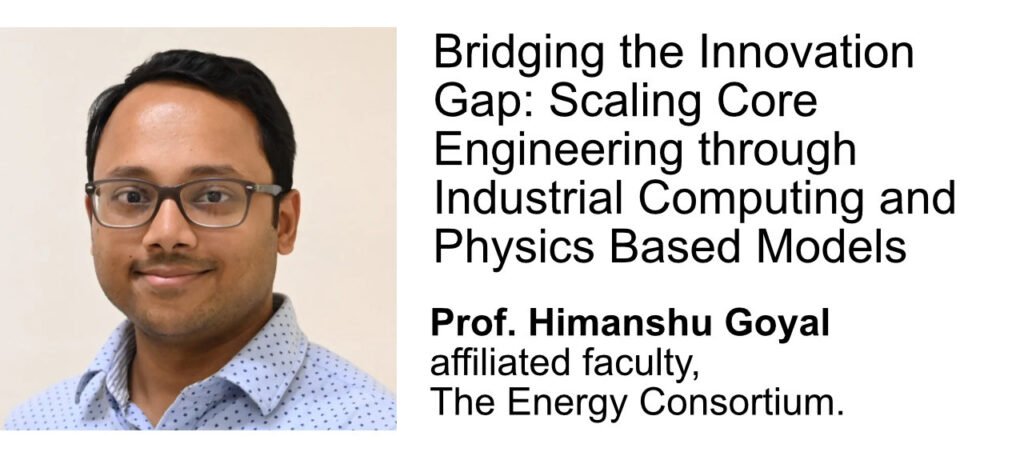
Prof. Himanshu Goyal is a faculty in the Department of Chemical Engineering at IIT Madras and an affiliated faculty of The Energy Consortium. Recently he was recognized with the Radha and PK Narayanan Early Career Chair Professorship. His research group develops modeling and simulation tools to explore the interplay between transport processes (heat, mass and momentum) and chemical reactions that are at the heart of clean energy and process intensification technologies. The Energy Consortium’s communications team sat down with Prof Himanshu to learn about his research focus and its applications.
Today, the journey of a new material from a lab-scale breakthrough to commercial implementation can take between 10 to 20 years and require an immense investment of capital and human resources. In a world demanding rapid decarbonization, this timeline is no longer acceptable. The objective of Prof Himanshu Goyal’s research group is to utilize computational resources to compress this innovation cycle, aiming to reduce the transition timeline from decades to a span of 5 to 10 years.
Over the past few decades, core engineering innovation within academia has experienced a noticeable decline. The primary focus of research has shifted significantly toward materials development—a necessary endeavor, but one that is incomplete without a corresponding evolution in process engineering. The central challenge of our era, specifically regarding climate change and the energy transition, is not merely the discovery of a new catalyst or a more efficient electrolyzer; it is the implementation of these technologies at scale.
A New Paradigm: From Art to Science
Historically, the design, optimization, and troubleshooting of large-scale industrial reactors have been treated more as an art than a science. Engineers have traditionally relied on previous experience, empirical heuristics, and “thumb rules” to navigate the complexities of industrial systems. While effective for incremental improvements, these methods are insufficient for the radical technological shifts required for Net Zero targets.
Prof Himanshu’s work aims to replace these experience-based techniques with science-based fast tools. He intends to provide industry leaders with a deeper understanding of the internal dynamics of their systems, allowing for designs based on fundamental scientific principles rather than trial-and-error.
The Methodology: Physics-Based Models and Digital Twins
The cornerstone of his approach is the development of digital twins—virtual representations of physical systems that allow for real-time simulation and optimization. His methodology relies on a dual-track strategy:
1. First-Principles Physics: He develops high-fidelity models grounded in the core principles of chemical engineering to understand what is happening inside complex systems.
2. AI and Machine Learning: He leverages AI and ML to build fast surrogate models. While high-fidelity simulations are accurate, they are often too computationally expensive for real-time industrial use. ML allows us to create leaner models that can deliver rapid insights without sacrificing scientific rigor.
A critical emerging trend in this field is the unification of AI with domain knowledge. Prof Himanshu believes that ML and AI tools are only truly effective when combined with a strong background in core engineering principles. Bridging these two worlds—the latest computational tools and fundamental chemical engineering—is essential for solving the industry’s most pressing problems.
Addressing the Industrial Scale-Up Gap
One of the most significant hurdles in industrial computing is the “Gap” between laboratory simulations and real-world application. While commercial simulation software is widely available, its utility is often limited to simple, lab-scale systems operating under ideal conditions.
Actual industrial commercial-scale systems are massive and involve complexities that are typically ignored in a laboratory setting. Prof Himanshu’s research focuses on bridging this gap by taking accurate, high-fidelity simulations from the lab and translating them into simple, fast models that remain robust when applied to real-world, commercial-scale reactors. These tools are designed for three primary industrial needs:
* Scale-up: Taking new technology from the lab to the field efficiently.
* Optimization: Designing systems to be more energy-efficient and carbon-neutral.
* Troubleshooting: Using scientific models to identify and solve challenges in existing processes.
Impact Across Key Industrial Sectors
The versatility of core engineering principles allows his computational tools to have a broad impact across various sectors. We have successfully collaborated with industry leaders to address diverse challenges:
* Petrochemicals, Oil, and Gas: Working with partners like Shell, he has applied these models to traditional refinery problems while also looking toward the future of energy.
* Fast-Moving Consumer Goods (FMCG): Collaborating with Unilever to apply chemical engineering fundamentals to the production and optimization of consumer products.
* Pharmaceuticals: Partnering with companies like Pfizer to develop models that enhance the precision of drug manufacturing and system design.
In each of these sectors, the goal remains the same: to provide tools that allow for more efficient design and the reduction of energy-intensive trial-and-error techniques.
The Path Toward a Sustainable Future
The transition to a sustainable economy requires a fundamental change in technology. Whether the focus is on green hydrogen based on electrolyzers or Carbon Capture, Utilization, and Storage (CCUS), the engineering scale remains the “missing link”. There are very few researchers globally working at the intersection of material science and engineering scale-up, and Prof Himanshu’s group at IIT Madras is dedicated to filling this vacuum.
By building computational tools that facilitate faster transitions, he is not just conducting a textbook exercise; he is engaging in work that has a real chance of making a significant global impact. The interest he has captured from industry partners validates the huge demand for these tools and motivates his team to continue pushing the boundaries of what is possible.
A Call to Collaboration
Receiving the Radha and PK Narayanan Early Career Chair has provided Prof Himanshu’s research group with increased visibility and the encouragement to pursue these ambitious goals. However, the journey from scientific theory to industrial reality requires a deep, ongoing partnership between academia and industry leaders.
The future of engineering lies in his ability to synthesize the “art” of industrial experience with the “science” of advanced computation. As he looks forward, his focus remains clear: leveraging AI, ML, and fundamental physics to ensure that the innovations of today become the industrial standards of a cleaner, more efficient tomorrow.