
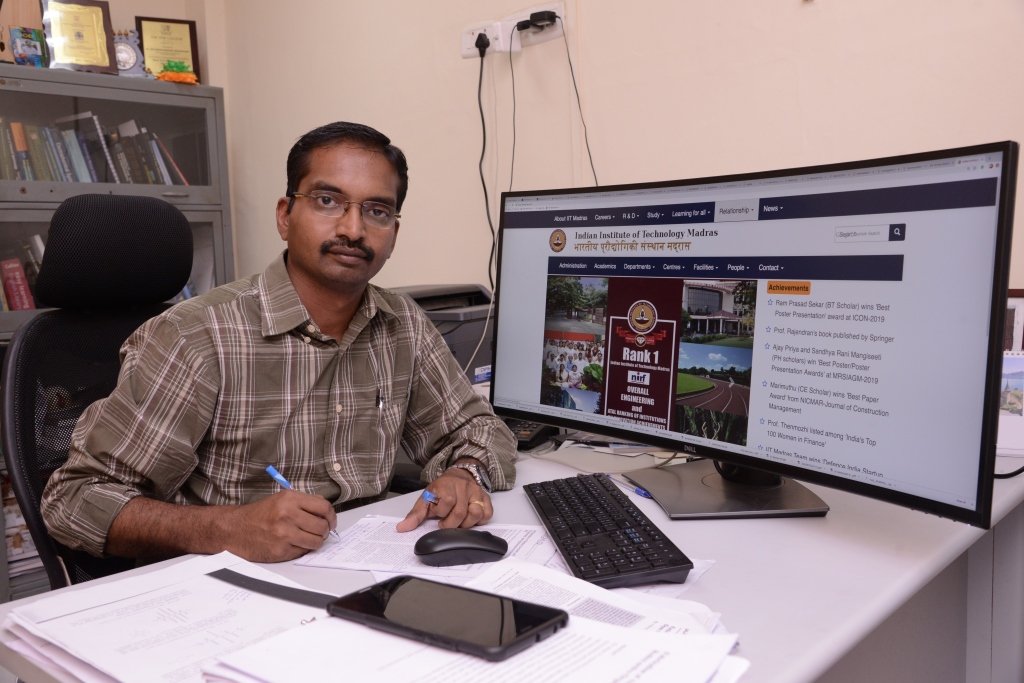
Interview with Prof. Kothandaraman, Annamalai & Santhi Rajendra Early Career Research Chair
In the global pursuit of a net-zero future, the transition from fossil fuels to renewable energy hinges on one critical bottleneck: energy storage. While laboratory breakthroughs are frequent, the path to commercial viability is often fraught with technical and supply-chain hurdles. Prof. Kothandaraman, recently recognized with the Annamalai & Santhi Rajendra Early Career Research Chair, is spearheading a paradigm shift in Indian energy research. His work focuses on translating fundamental electrochemistry into Minimum Viable Products (MVPs), prioritizing India’s strategic independence and the practical needs of the industrial sector.
The Philosophy of the Minimum Viable Product (MVP)
For academia and industry to converge effectively, Prof. Kothandaraman advocates for a shift away from “beaker-scale” demonstrations toward pilot-scale evaluation. His chair professorship, a three-year tenure driven by performance reviews, is built on the objective of developing field-ready technologies.
A prime example is the development of a 10 kW – 50 kWh vanadium redox flow battery (VRFB) with indigenous electrolyte and membrane, which has already moved from the laboratory to the field. Deployed at High Energy Batteries’ premises, this unit is currently undergoing technoeconomic and durability evaluations. This field-first approach ensures that research is not merely a theoretical exercise but a commercially vibrant pursuit capable of solving real-world energy problems.
Strategic Indigenization and Energy Sovereignty
A recurring theme in Prof. Kothandaraman’s research is the pursuit of India-centric solutions. While sodium-ion batteries are often touted as a “plentiful” alternative to lithium, he cautions that the host materials required—such as nickel, cobalt, and manganese—remain heavily dependent on imports.
To achieve true energy independence, his team is focusing on 80% indigenization in energy storage systems. In current megawatt-hour plant designs, the electrolyte, design, flow frame, and membranes are all developed and manufactured within India. By utilizing materials plentiful in the Indian subcontinent, such as Zinc, Iodine, and Bromine, his lab is creating a secure supply chain that circumvents the geopolitical risks of mineral scarcity at the same time offering energy storage capacities much higher than VRFB
Notably, the Zinc-Iodine battery offers a distinct advantage in the circular economy: iodine can be recovered through sublimation, transitioning directly from a solid to a gas, making the recycling process both economically viable and environmentally sustainable without requiring additional chemicals for recycling.
Breakthroughs in Hydrogen and Carbon Valorization
Beyond storage, the research extends to the “greening” of industrial processes through innovative electrochemical reactors.
Decoupled Hydrogen Generation: Traditional water electrolysis carries the risk of hydrogen being contaminated by oxygen, necessitating complex and difficult-to-maintain system designs. Prof. Kothandaraman has pioneered a decoupled electrolysis system using a three-electrode setup. By producing hydrogen and oxygen in a staggered manner, the system enhances gas purity and simplifies maintenance, offering a more robust prototype for industrial-scale hydrogen generation.
Carbon Dioxide Conversion: To address climate change, his team in collaboration with Prof Ramanathan S has developed reactors that convert CO2 into formic acid and carbon monoxide with a remarkable 90-95% efficiency. Carbon monoxide, as a component of syngas, is a highly sought-after industrial raw material, turning a greenhouse gas into a value-added reagent for the chemical sector. Since this reactor also produces hydrogen as byproduct, a gross margin model considering value of formic acid, CO and H2 indicates it as a profitable process.
Solving Practical Engineering Challenges: The Flow Battery Test Rig
In the burgeoning field of flow batteries, standardization has been a significant hurdle. Researchers often face electrolyte shifting due to osmotic pressure differences, which leads to capacity imbalance.
Prof. Kothandaraman’s team has developed a specialized flow battery test rig that balances pressure drops countering electrolyte shifting. This allows the battery to maintain capacity balance over hundreds of cycles, performing as efficiently in the field as it does in its first cycle. By providing this standardized rig to the broader research community in India, he allows other scientists to focus on redox molecule innovation rather than mechanical troubleshooting.
A Global Academic and Industrial Network
The impact of this research is amplified through robust international and domestic partnerships. A flagship collaboration is the Australia-India Strategic Research Fund (AISRF) project with the University of Southern Queensland, focused on the eco-friendly recycling and repurposing of battery materials.
Further expanding his global footprint, Prof. Kothandaraman has established research ties with institutions in Taiwan, Singapore, and Malaysia. Domestically, he has completed NPTEL courses on electrochemistry and battery technologies, specifically designed for industry professionals, ensuring that the next generation of engineers is equipped with the knowledge to manage these emerging technologies. For past several years he is active in organizing several international conferences at IIT Madras, with the support of Energy Consortium and Global Engagement Office at IITM, expanding the research network and internationalization at IIT Madras. The upcoming 3rd edition of IECS conference is in July between 13 to 17th at IITM (iecsconf.net; International conference on energy conversion and storage)
Repurposing Legacy Resources: The Coal Transition
As India pivots toward renewables, legacy industries like coal face obsolescence. Prof. Kothandaraman is working with Coal India to convert coal into value-added products like graphite and hard carbon. These materials serve as essential anodes for batteries or bipolar plates for fuel cells, offering a pathway to transition traditional coal resources into the clean energy supply chain.
The Future of Energy Research: A Vision for Academia
The Annamalai & Santhi Rajendra Early Career Research Chair serves as a vital endorsement of application-oriented research. For Prof. Kothandaraman, the award signals to the global community that solving tangible energy problems is as prestigious as fundamental discovery.
His “piece of wisdom” for the academic community and future chair professors is clear: prioritize field demonstration. The most effective research portfolios balance fundamental science with demonstrated pilot-scale projects. In a world where many claim to work on sustainability, the true measure of success is the ability to translate a laboratory concept into a commercially viable product that can be showcased in the field.
Through indigenization, innovative engineering, and a commitment to the circular economy, Prof. Kothandaraman is not just researching the future of energy—he is building it, one MVP at a time. This holistic approach ensures that India remains at the forefront of the global energy transition, transforming environmental challenges into indigenous economic opportunities.